


Around the world, cities are facing mounting pressure to feed a growing population with fewer resources and increasing trade and economic uncertainty.
Calgary is responding to this shared challenge by harnessing the value of its agribusiness industry. Across the region, producers, processors, innovators and logistics partners work together to transform how food is grown, processed and delivered.
With sector expertise, global connectivity and a skilled talent pool, Calgary has become a magnet for Canadian and international agribusiness and agtech companies. In 2024, the agribusiness sector contributed $13.5 billion to Alberta’s GDP and employed more than 76,000 people.
As global demand grows to feed 10 billion people by 2050, the Blue Sky City provides fertile ground for companies transforming how we feed and fuel communities worldwide.
The Calgary and Alberta Ag-vantage
Few regions can produce, process and innovate at scale, making Calgary and southern Alberta stand apart.
The province is home to nearly 50 million acres of farmland, almost 5 million head of cattle and 70 per cent of Canada’s irrigated land, supporting strong primary production in pulses, oilseeds and livestock.
Beyond the traditional resources, Calgary’s climate, abundant sunlight and natural gas infrastructure also make it an ideal location for controlled environment agriculture and year-round food production.
Innovators like Hydragreens and Trafford Farms use advanced technology to boost local food security. They grow fresh produce indoors 365 days a year without pesticides or herbicides, while significantly reducing water, land and energy use.
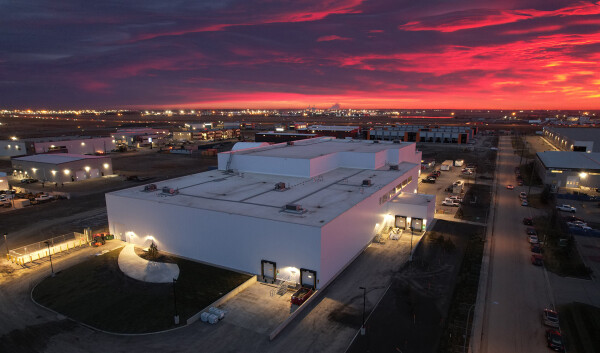
GoodLeaf Farms' 96,000 sq. ft. Calgary facility opened on Apr. 30, 2024.
Calgary is also emerging as a national centre for vertical farming. GoodLeaf Farms, Canada's only national and largest vertical farming operator, opened a $52 million facility in Calgary in 2024. Using a hydroponic system, the farm produces millions of pounds of fresh greens annually, while creating jobs and strengthening the region’s food supply chain.
In Nov. 2025, GoodLeaf invested an additional $52 million to expand operations in Calgary, Alberta and Quebec, with plans to double capacity in 2026.
With one of Canada’s largest concentrations of primary crop and livestock production, Alberta’s opportunity for value‑added processing is equally significant — enabling companies to source raw ingredients locally and turn them into higher‑margin products on-site.
These companies have a built-in advantage to scale from the region, with access to incentives like the Growing Greenhouses Program and the Alberta Agri-Processing Investment Tax Credit.
A hub for agribusiness companies, capital and talent
Behind the sector are Alberta’s bright minds with big ideas — powered by a specialized workforce and the presence of global leaders like Nutrien, Bayer and BASF headquartered here.
Educational institutions in the region are cultivating the next generation of agribusiness innovators through hands-on training and applied research.
This includes the 3,300-acre Olds College Smart Farm, one of the world’s only ag-tech corridors, and the University of Calgary’s 19,000-acre W.A. Ranches, where industry and academics can test their technologies at scale.
In Dec. 2025, Calgary’s innovation capacity expanded further with the launch of AgSphere, a new agrifood innovation hub funded by the Opportunity Calgary Investment Fund and created in partnership with the Calgary Stampede and Olds College of Agriculture and Technology. AgSphere serves as a gathering place for producers, startups, researchers and investors to accelerate commercialization and collaboration.
Within the hub and the local innovation ecosystem, Calgary attracts agtech investors and startups thanks to a support system of ag-focused accelerators and venture capital funds, including:
Together with AgSphere, these partners form Calgary’s ‘agribusiness node’ within Calgary’s Innovation Strategy. With a bold goal to position Calgary as the innovation capital of Canada, collaboration across sectors is expected to create up to 187,000 jobs and add $28 billion in economic activity by 2034.
Calgary is globally connected and export ready
Producing sustainable food to feed the world is just one part of the equation — the ability to move it efficiently to market is another.
As Western Canada’s Inland Port, Calgary provides unmatched connectivity as an ideally positioned distribution hub with air, rail and road connections reaching millions daily.
The city is home to one of Canada’s busiest airports, a major cargo hub, Class 1 rail access in all directions and highways linking coast to coast. Businesses can reach up to 16 million customers within 24 hours by truck, giving Calgary a competitive advantage in distribution and agri-food exports.
In 2024, Alberta’s producers fed the world with over $17.5 billion of primary agriculture commodities and value-added agriculture products exported globally.
From farm to global markets, Calgary’s agribusiness sector shows how a region can grow, transform and distribute food for a changing world.

Photo: CPKC
Learn more about the vision for Calgary’s future in the economic action plan, Uplook, and explore the possibilities of the Calgary region’s agribusiness sector here.